


Cathedral Basilica of Saints Peter and Paul, Philadelphia
- Interspace & Power

- Dec 1, 2024
- 4 min read
Location: Philadelphia, PA, USA
Architect: Napoleon LeBrun, John Notman, John Mahoney, Constantino Brumidi (interior)
Style: Neo-classical
Completed in: 1864
Denomination: Catholic

The Cathedral Basilica of Saints Peter and Paul, located on 18th Street near Logan Square in Philadelphia, is the largest Catholic church in Pennsylvania and the head church of the Archdiocese of Philadelphia. It reflects a significant chapter in the diocese’s history and is the largest brownstone structure in Philadelphia.
Philadelphia, founded in 1682 by William Penn as a haven for religious freedom, played a pivotal role in early American history. Known as the "City of Brotherly Love," it became a center for colonial politics, commerce, and culture. Philadelphia hosted the First and Second Continental Congresses and was the site where the Declaration of Independence (1776) and the U.S. Constitution (1787) were drafted and signed. The city also served as the nation's capital from 1790 to 1800. As an industrial hub in the 19th and early 20th centuries, it attracted diverse immigrant populations.
In the 19th century, Philadelphia transformed from a colonial capital into a bustling industrial and cultural hub. Massive immigration, particularly from Ireland and Germany, reshaped the city’s demographics but also fueled tensions, including the anti-Catholic riots of 1844 where Catholic churches and homes were destroyed.
The cathedral’s construction was initiated in the middle of anti-Catholic circumstances and its solid, fortress-like brownstone design was a deliberate response to such social insecurity at that time. Led by the then-Bishop Francis Kenrick, the cathedral was envisioned as a spiritual and architectural symbol of strength and faith for the growing Catholic community in the city.

"Cathedral is cladded with brownstone"
The cathedral was designed by Napoleon LeBrun in the Neo-Classical style, reflecting Bishop Kenrick's preference over Gothic architecture. While its design incorporates features like barrel arches, Corinthian columns, and triangular pediments, the high placement of windows at the clerestory level likely stems from concerns over anti-Catholic violence.
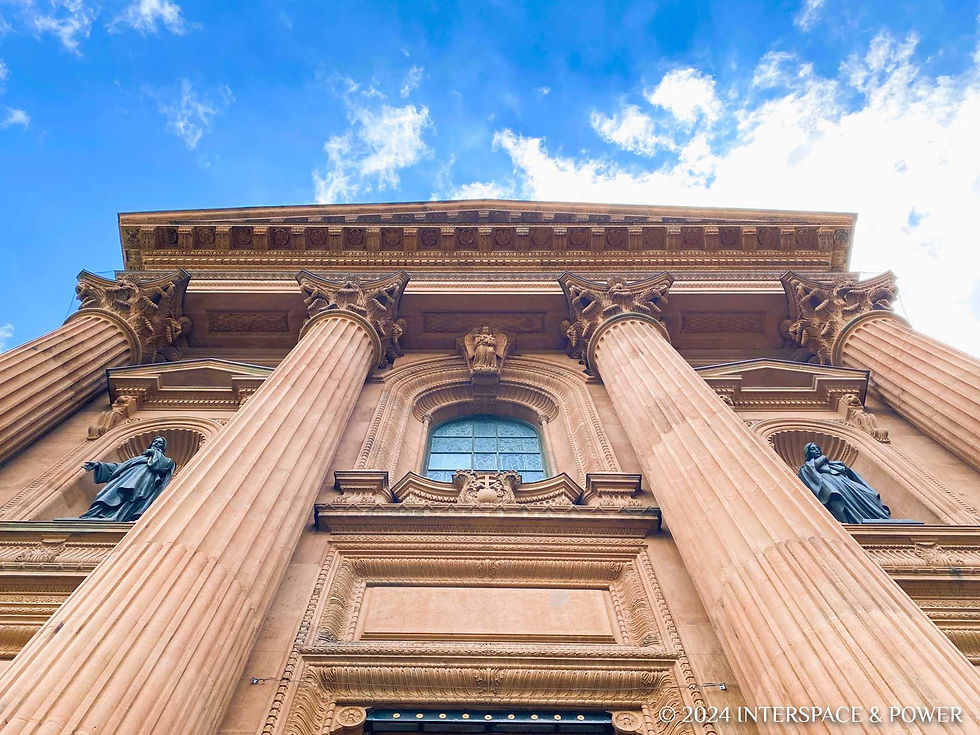
"Corinthian columns and pediments"

"No windows at lower level to avoid anti-Catholic violence
Although the exterior of the building was completed in 1864, the interior remained largely unfinished and it took years of intensive work to complete the interior. The interior decorations were crafted by Constantino Brumidi, known for his work in the U.S. Capitol in Washington, DC. Rich materials, including marble and walnut, adorn the space, while gilded details and sculptural elements add to its grandeur.

"Interior work done by Constantino Brumidi"
Between 1956-57, major renovations to the Cathedral were carried out including the construction of the semi-circular apse for the main altar. The main altar consists of 11.5 m high baldachin made of Italian marble surmounted by a dome of bronze panel. The floor is of white and dark green marble tiles where a white-marble altar rail, with bronze gates, divides the nave and transept from the sanctuary.

"Main altar, baldachin and bronze gates"
The choir stalls, made of American black walnut, separate the sanctuary from the side altars by the intricately hand-carved wooden screens. The Cardinal-Archbishop's throne, Cathedra is also crafted from American black walnut. The coat of arms of the Archdiocese's leader can be seen beneath the throne's canopy.

"The Cathedra and Choir Stalls"

"The Cathedra and its canopy"
The Northside Altar, originally designed by architect Napoleon LeBrun, was installed in 1887 and dedicated to the Blessed Virgin Mary. Above the altar hangs the celebrated Venetian glass mosaic of The Assumption of the Blessed Virgin Mary. Created in Venice, Italy in 1915, the mosaics were delayed in transit due to World War I and were finally installed in the Cathedral in 1918.

"Northside Altar"
The ambo, positioned across from the Cathedra, features an octagonal design. Crafted from imported marble that complements the altar, it is topped with a carved walnut canopy. The front displays the Greek symbols alpha and omega, signifying the beginning and the end. On the rear wall, the Holy Spirit is symbolized by a dove surrounded by rays, representing the seven gifts of the Spirit.

"Ambo"
The great dome of the Cathedral Basilica of Saints Peter and Paul rises approximately 48 m and features in total 1862 paintings.

"The great dome"
The choir loft and organ are located at the rear upper level of the Cathedral, featuring a carved walnut organ screen designed by Otto Eggers. The organ screen has a curvature so that the majestic stained-glass window of the Crucifixion of Jesus over the main entrance can also viewed from inside. The Cathedral organ ranks among the largest in Philadelphia, including 75 ranks, 90 stops, and 4,648 pipes distributed across four manuals and pedals.

"Choir loft and organ"

"An inscription above the organ honors Saint Paul as a "chosen instrument."
References:
Cathedral Basilica of Saints Peter and Paul. (n.d.). About the Cathedral. Retrieved from https://cathedralphila.org/about/about-the-cathedral/
Cathedral Basilica of Saints Peter and Paul. (2019). Self-guided tour of the Cathedral Basilica. Retrieved from https://cathedralphila.org/wp-content/uploads/2019/08/Self-guided-tour.pdf
Catholic Historical Research Center of the Archdiocese of Philadelphia. (n.d.). Cathedral Basilica. Retrieved from https://chrc-phila.org/cathedral-basilica/
Wikipedia contributors. (n.d.). Cathedral Basilica of Saints Peter and Paul (Philadelphia). Retrieved from https://en.wikipedia.org/wiki/Cathedral_Basilica_of_Saints_Peter_and_Paul_(Philadelphia)


Comments